Content teams are confusing activity with progress
AI has made it easier to build pages, tools and workflows. The harder question is whether any of them deserve to be built—and who should own them once they exist.

A competitor launches an interactive calculator. Someone drops it into Slack. Within half an hour, the conversation has moved from “Would this help our audience?” to “Could we build one?” There's talk of AI, a landing-page refresh, a new visual treatment, and perhaps a tiny tool that could be ready by Friday.
The idea might be good. But notice how quickly the team has skipped to making it.
AI has changed that conversation because the first version of almost anything now feels within reach. A content marketer can mock up a page, generate a visual, build a rough calculator or write code for a small tool without waiting for three people and a sprint. This is genuinely useful. It also makes new work look cheaper than it is. The build is only one part of the bill; somebody still has to check it, get it approved, measure it, fix it and keep it working.
Start with the business problem, not the deliverable
“We need a calculator” is a proposed solution. “Buyers can't tell whether this option is worth paying for” is a problem. Those are not interchangeable.
This is one way a content team can look busy while losing the plot: we become attached to formats before we've got clear on the problem. We decide we need a blog, a webinar, an interactive, a comparison page or an AI workflow because the format is familiar, fashionable or suddenly easy to make.
Get clear on what needs to change before choosing the approach, and choose the format last. “We need a blog” is a deliverable, not a business problem. Neither is “we could vibe-code this by tomorrow.”
Try writing the problem in one sentence before you discuss the asset. For example: “Buyers comparing these options struggle to understand the ongoing cost of maintaining a home-built solution.” Now a comparison page, calculator, short video or sales-enablement sheet might help. You can choose between them instead of falling in love with the first one someone suggests.
Five questions to ask before work gets a slot
You don't need a 30-column scoring sheet to prioritize well. You need a few questions the team will actually use, including when the request comes from someone senior.
- What are we trying to change? Name the audience and outcome, not just the topic or deliverable.
- What makes us think this matters? Look for customer questions, sales objections, search behavior, product data or a real gap. An executive's hunch can be worth checking, but it is only a starting point.
- Why now? Is there a launch, a change in buyer behavior, a market window or a cost to waiting? “Everyone is talking about it” is not a deadline.
- What will this push out? Every yes spends time that already belongs to something. Name the task, experiment or maintenance work that will slow down if this gets priority.
- Who owns the result after launch? If the answer is “we'll keep an eye on it,” ask who, how often, and what they are expected to do when something breaks.
The fourth question is the one teams are most tempted to dodge. They will happily add a new project to the roadmap; they are less keen to name the thing that has to move. But capacity doesn't appear because a spreadsheet has a new row.
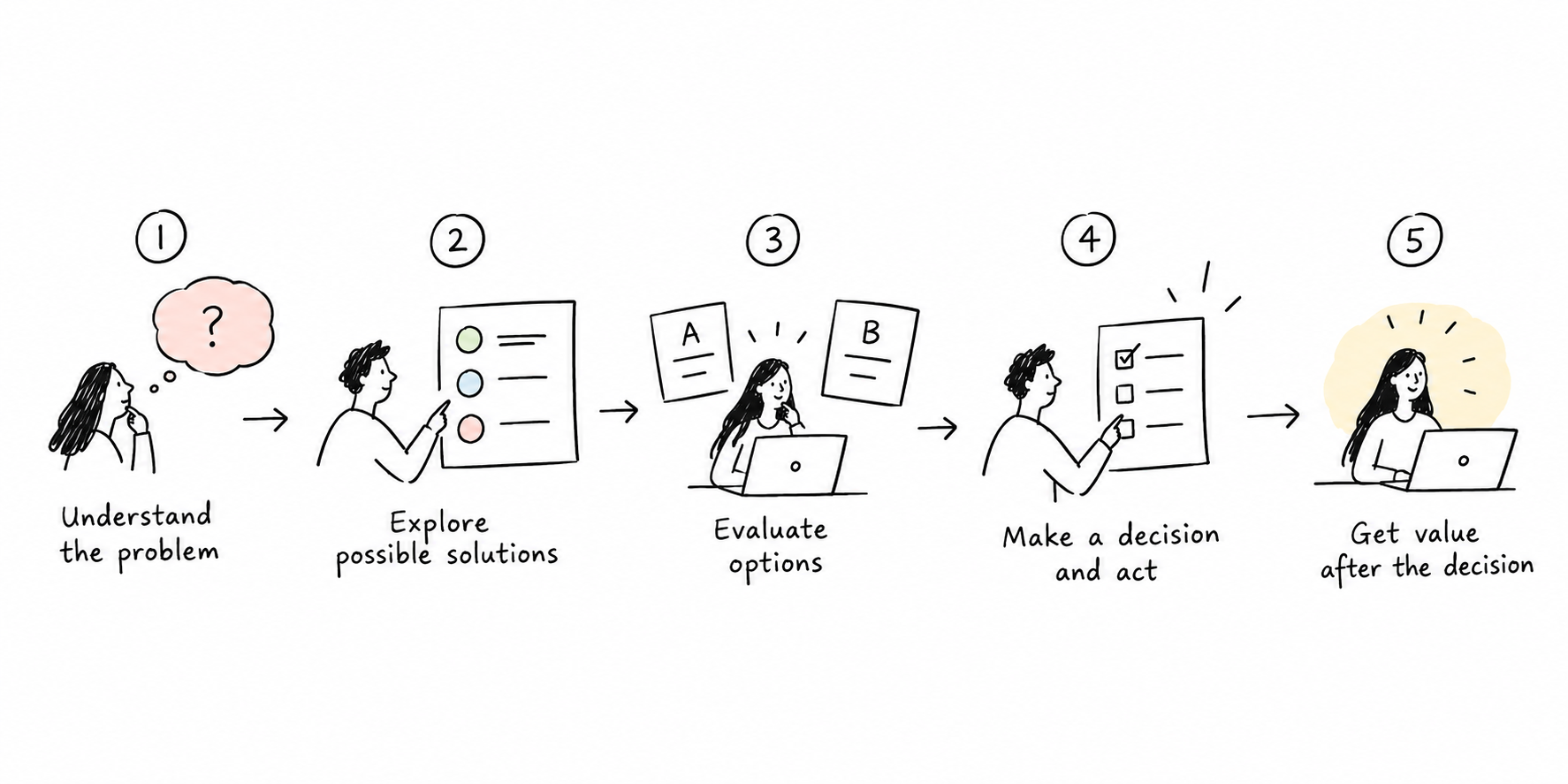
Choose one of four next steps
Once the idea has survived those questions, make an explicit call. I like four options because they force a decision without pretending every idea can be ranked to the second decimal place.
Put it on the roadmap and define success.
Run the smallest useful experiment.
Record what would make you revisit it.
Explain what is missing or why it isn't worth the cost.
This isn't meant to turn content planning into a courtroom. Sometimes you should try the interesting thing because the downside is tiny and the learning could be useful. The point is to know when you're making a deliberate experiment rather than quietly adopting another permanent responsibility.
Give one idea a reality check
Pick a project you're considering. Answer honestly; this is a thinking aid, not a magic scoring model.
AI has blurred the line between what we can build and what we should own
When a content team can use AI to build a landing page or a mini-tool, the old division of labor starts to look negotiable. Should we build it ourselves? Ask design? Queue it with engineering? Give the time to another content project instead?
I'd separate prototyping the idea from owning the thing in production.
Content should own the audience problem, message, customer insight, brief and measure of success. AI can help the team explore a layout, test a headline in context, mock up an interaction or build a low-risk prototype. That gives design or engineering something concrete to react to instead of a brief that says “make it more engaging.”
But the ability to generate working code doesn't automatically make the content team the right owner for it. If a page touches shared components, integrations, customer data, security, accessibility, performance or ongoing maintenance, involve the people responsible for those things. A clever proof of concept can still be a terrible production system.
A quick prototype can look cheaper than an existing tool until you count engineering time, maintenance, security and compliance. The same logic applies inside a marketing team: the first build is not the full cost of owning it.
Content owns
The audience problem, positioning, message, customer insight, content experience and success measure.
Prototype with AI
Low-risk layouts, copy variations, approved-CMS pages, internal tools and reversible experiments.
Co-build
Shared templates, integrations, sensitive data, complex interactions, production code and anything the team cannot maintain.
This isn't a rule that engineering must approve every button color, nor is it a permission slip for marketing to launch whatever a model produces. Agree on the boundaries once, then give people room to work inside them.
Don't use the time AI saves to automatically make more things
AI can speed up a first draft or first build, but the work still needs a careful review: verify figures, find missing information, test edge cases and catch confident mistakes. Time saved in production can reappear as review time, especially when the person checking the output lacks the context to spot what is wrong.
That doesn't make AI useless. It means the benefit depends on what you do with the time and where you put the human checkpoints. Use AI for work that is repeatable and easy to verify. Keep human judgment close to the parts where a mistake could change the argument, misrepresent a customer or create a promise the product cannot keep.
When AI really does save a few hours, resist the urge to fill those hours with two extra deliverables. Spend some of them on the work that tends to get squeezed out: talking to a customer, reading the source material, checking whether the premise holds, or deciding that the proposed piece isn't worth making.
Try this in your next planning meeting
Take the three to five new requests most likely to compete for time. For each one, write down the problem, what makes it worth doing, why now, what it would displace and who owns it. Choose commit, test, park or decline. For anything involving an AI-built page or tool, make one more call: content-owned, prototype-first or co-built with design or engineering.
One last question is worth keeping around: What would we have to put off to make room for this? If nobody can answer, don't let the ease of building it decide for you.
A content team will always have more ideas than time. AI widens that gap. The advantage isn't being able to make everything on the list; it's choosing the few things worth making, testing the uncertain ones cheaply, and letting the rest go without a funeral.